
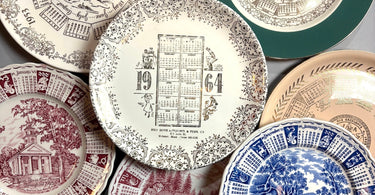
Calendar plates have always had a special spot in decor. They are nice to look at and have a perceived value added because they have useful information.
Calendar plates from just past the turn of the century packed even more punch. They were often gifted to loyal customers by businesses, personalized with information about that business. Unlike a stress ball you might drag home from a trade show today, these plates were "art," something you could hang on your wall and admire. Plate giveaways were popular from 1906-1920, but had faded from the scene by 1929.

1911 Ark House Furnishings Co., Riverside, CA plate.
Calendar plates rose in popularity again in the 1950s, still as promotional items. They might have a pastoral or patriotic scene as well as the business's name. Banks and insurance agents loved giving these out, but they were also popular giveaways with feed stores, funeral homes and and churches.
By the 1960s, calendar plates were becoming a retail decor item, sold at department stores, gift shops, museum stores and tourist shops. Like most trends, they ranged in quality from souvenir grade to nicer transferware pieces from known British potteries. Well known 1960s makers included the usual suspects from England: Alfred Meakin, Johnson Bros., Royal Stafford, Adams, Ridgway and Myott. The American companies included Homer Laughlin, Taylor, Smith & Taylor, Knowles and Vernon Kilns. European exportware came from Villeroy & Boch, Hutschenreuther and Goebel. And Japanese makers Lefton, Enesco, Norcrest and Napco also made designs.
Collectibles sellers got in on the game in the 1970s. Calendar plates were marketed as "keepsakes," decor that had lasting value. Plates were still available at all the same places as the 1960s, and were made by many of the same makers, but they were also beginning to be sold by annual subscriptions with a heavy emphasis on them being a good investment. Collectibles are rarely good investments, and calendar plates were no different.
Additionally, the 70s trend of stoneware dinnerware brought calendar designs from US makers like Red Wing, McCoy, Pfaltzgraff and Frankoma.

1977 Wedgwood calendar plate.
The 1980s was when the collectible and mail order companies fully took over. Companies like the Franklin Mint, Bradford Exchange, Danbury Mint, Knowles Collectors Guild, Gorham and Wedgwood reigned supreme. You got your numbered piece, certificate of authenticity and a sturdy shipping box that you put in the attic for safe keeping. These might feature licensed art from well known collectibles artists. Say what you want about the collectibles makers, but they do offer really nice quality porcelain plates.
The gift tier wasn't going to be left out. Avon, Hallmark, Gibson, American Greetings and Lenox offered calendar plates, all of which, with the exception of Lenox, were commissioned from other makers.
How to date calendar plates?
When was something made is a question always front of brain for vintage sellers. With a lot of ceramics, you have to sleuth out their age by looking at changes in maker backstamps over time or figuring out what years a particular pattern was made. Blissfully, there is no sleuthing to figure out the age of a calendar plate. It's self evident. We like that. Finally, a piece of china that's easy to date!
Why would you buy a vintage calendar plate?
First of all, they are very decorative. If you are building a plate wall of transferware, a nice calendar plate in the right color will fit in beautifully. If you love nostalgic American scenes, calendar plates fit right in. If you are into astrology, many have the zodiac motifs.
Another reason to shop for a vintage calendar plate is to mark an important date or anniversary. A plate from someone's birth year is a kind of cool thing.
And how about as a new home gift? Gifting a mid-century plate from the year a house was built is going above and beyond.
Can you use calendar plates as china?
Some of it you can, most of it you cannot.
If it's a plate that's stamped in a metallic gold, nope. If it's from the 1980s and sold exclusively as decor, nope. If it has hand painted details, nope.
Some of the British transferware plates are marked that the design is under the glaze and the plate is detergent and acid resisting. Those you could use as dinnerware because the decoration is sealed in with a clear coat.
