
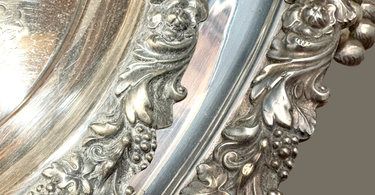
It all started with two vintage 1930s silver plate serving pieces. One is a meat platter marked Birks-Ellis Regency Plate. The other is a butler tray, marked on the back with the menorah used by Barker-Ellis. Two different pieces, two different makers. So why do they have the same border pattern?

Like all good vintage sleuths, we dove directly into the rabbit hole to get to the bottom of why two makers might have the same pattern, and started with examining the history of both companies. Is this essential? No. But we love a good company history.
The Birks-Ellis story had a lot of mergers. The P.W. Ellis Company was founded by a pair of brothers in Toronto in 1877, and was known for it's fine quality jewelry, flatware and hollowware serving pieces. Henry Birks & Sons was a luxury retailer of fine jewelry and flatware, founded in Montreal in 1879. Henry Birks & Sons was and is considered the "Tiffany of Canada."
In 1905, Henry Birks & Sons formed a partnership with the P.W. Ellis Company and Ryrie Co., a Toronto luxury retailer, linking up their names and doing business as Birks-Ellis-Ryrie. Birks bought both Ellis and Ryrie in 1928, chopping off the Ryrie name. Birks-Ellis was used until 1933, when they chopped off the Ellis and became Birks, just Birks.

The marking on the meat platter is Birks-Ellis Regency Plate. Regency Plate was their line of high quality silver plate meant to compete with English Sheffield plate. It was made from 1928 until it was phased out in the early 90s when the consumers lost their love of silver plate. But we know the meat platter has to be from sometime between 1928 -1933 because that's the only time it was marked Birks-Ellis Regency Plate. After 1933, it was Ellis Regency Plate.
Now, to butler tray marked with the menorah stamp of English maker Barker-Ellis. Barker-Ellis, or Ellis-Barker as it is called in the US and Canada, was one of the important English makers of Sheffield plate and EPNS (electro-plated nickel silver).

Founded in 1801 in Birmingham, England (home to many good things including Ozzie Osborne), Barker Brothers grew into one of England's largest manufacturers of plated goods. In 1906, Barker Brothers bought their Birmingham neighbor, the Ellis Silver Company and became Barker-Ellis. The company began using the menorah mark in 1912.
Barker-Ellis was eventually bought by an American company, Towle Silversmiths, in the 1970s. Their hallmark disappeared by the end of the 20th century.
Now we know these are two distinct companies in two different countries, but that doesn't get us an inch closer to why one company in Canada and one in England would have the same border pattern. Or does it?
Barker-Ellis/Ellis-Barker was sold in a many fine department stores and specialty retailers in the US and Canada from the 1920s-1940s...including Birks. Not only that, Barker-Ellis manufactured pieces of Birks Regency Plate. One company, making pieces under two names. That's how both pieces got the same border.
Pieces made for Birks were usually marked with Birks-Ellis Regency Plate (from 1928-1933) or Birks Regency Plate after that. Some pieces also had both the Barker-Ellis menorah and Birks marks. These pieces belonged to the same person and were likely both purchased in Canada at Birks. But it is kind of weird that the meat tray has the Birks-Ellis Regency Plate mark and the butler tray only has the menorah.
No amount of digging the rabbit hole deeper is going to answer that. So we might as well make guesses. Maybe butler trays with only the menorah mark got shipped to Birks instead of the retailer they were intended for. Maybe Birks needed more pieces in that pattern STAT and couldn't wait for Barker-Ellis to make more. It would have taken a long time for those pieces to make their way from Birmingham, England to Toronto, Canada and they needed the inventory for wedding season. Maybe the original freighter with the Birks marked pieces was swamped by a kraken, so Barker-Ellis, after a period of mourning for the crew, shipped replacements.
Whatever the reason, we consider the curious case of why two silver plate pieces by two different makers have the same pattern closed.
